

All-Season Tyres
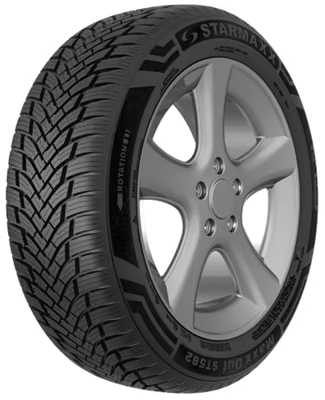
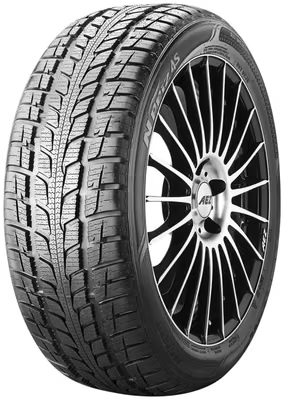
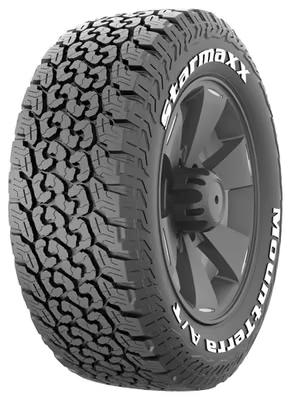
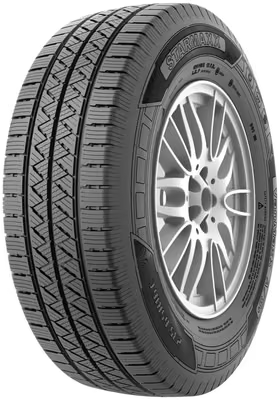
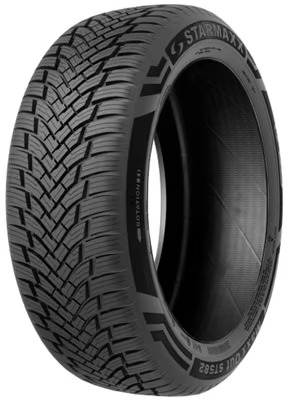
All-season tyres are designed to be used all year round without seasonal changeovers. They suit drivers who cover relatively few kilometres a year and mostly drive in town. In Lithuania, all-season tyres marked M+S are legal for winter use, but they fall short of winter tyres on snow and ice, and of summer tyres in summer heat. Read the guide


 M+S
M+S
Stock in stores
M+S
Stock in stores
M+S
Stock in stores
 M+S
M+S
Stock in stores
 M+S
M+S
Stock in stores
M+S
Stock in stores
 M+S
M+S
Stock in stores
M+S
Stock in stores
M+S
Stock in stores
M+S
Stock in stores
M+S
Stock in stores
M+S
Stock in stores
M+S
Stock in stores
M+S
Stock in stores
M+S
Stock in stores
 M+S
M+S
Stock in stores
M+S
Stock in stores
M+S
Stock in stores
M+S
Stock in stores
M+S
Stock in stores
M+S
Stock in stores
M+S
Stock in stores
M+S
Stock in stores
M+S
Stock in stores
Who all-season tyres suit
All-season tyres are worth considering if:
- you mostly drive in town and on cleared streets;
- you drive relatively few kilometres a year and can leave the car parked in heavy snow or when the roads are icy;
- you want to avoid seasonal changeovers and storing a second set;
- it is a second family car that is rarely driven in winter.
If you often drive out of town, over long distances or on poorly maintained roads, two sets – summer and winter tyres – are the safer choice.
Are all-season tyres legal in a Lithuanian winter?
Legal requirement: from 10 November to 31 March, vehicles with a gross weight of up to 3.5 t must use tyres intended for winter and marked M+S or with the three-peak mountain snowflake symbol (3PMSF), as set out in point 5.5 of the list of technical requirements for motor vehicles and their trailers approved by the Lithuanian Transport Safety Administration (LTSA). This means that in Lithuania all-season tyres marked M+S meet the requirement. During this period, tyres on passenger cars (M1) and light commercial vehicles (N1) must have a tread depth of at least 3.0 mm.
Where they fall short of seasonal tyres
- Snow and ice. Sipes and a softer compound help, but on ice and in deep snow all-season tyres fall short of winter tyres.
- Heat. In summer, braking distances are usually longer than with summer tyres, and the tread wears faster.
- Handling. A tread with more sipes can be noisier on the motorway and less precise in corners than a summer tyre.
- Tread depth. Worn all-season tyres lose their snow grip first, so we recommend replacing them when the tread depth is down to about 4 mm.
3PMSF or just M+S
Choose all-season tyres with the three-peak mountain snowflake symbol (3PMSF): it means the tyre has passed a standardised snow grip test. M+S is a manufacturer's marking with no mandatory test, so it tells you little about winter performance on its own. In Latvia, Estonia and Finland, the M+S marking alone is no longer enough for winter, so check the marking before a winter trip to these countries. More in our article on the 3PMSF symbol.