

Studded Tyres
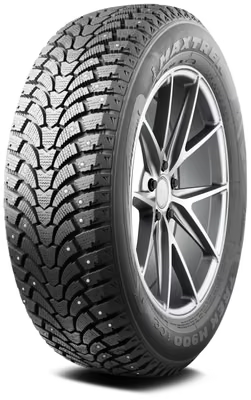
Studded tyres have metal studs set into the tread, which gives them the best grip on ice and packed snow. In Lithuania they are allowed from 1 November to 9 April, and the car must display a studded tyre sign on the rear. They suit drivers who often use icy rural roads in winter.
2447 matching results


 M+S
M+S

Stock in stores
 M+S
M+S
Stock in stores
M+S
Stock in stores
 M+S
M+S
Stock in stores
M+S
Stock in stores
M+S
Stock in stores
M+S
Stock in stores
M+S
Stock in stores
M+S
Stock in stores
M+S
Stock in stores
 M+S
M+S
Stock in stores
 M+S
M+S
Stock in stores
M+S
Stock in stores
M+S
Stock in stores
M+S
Stock in stores
M+S
Stock in stores
M+S
Stock in stores
M+S
Stock in stores
M+S
Stock in stores
M+S
Stock in stores
M+S
Stock in stores
M+S
Stock in stores
M+S
Stock in stores
M+S
Stock in stores
24 from 2447 products displayed
When studded tyres are allowed
Legal requirement: the Road Traffic Rules (point 229) prohibit driving on studded tyres from 10 April to 31 October, which means they are allowed from 1 November to 9 April. If winter conditions persist, the Minister of Transport and Communications can extend this period. Winter tyres become mandatory on 10 November, so studded tyres can be fitted a little earlier.
Warning sign and fitting
Legal requirement: a car on studded tyres must display a sign on the rear: a white equilateral triangle with a red border and a stud symbol in the middle (sides 200–300 mm long). Under the list of technical requirements for motor vehicles and their trailers approved by the LTSA, tyres on the same axle must be of the same construction type, size marking and intended use, and from 10 November to 31 March passenger cars (M1) and light commercial vehicles (N1) need a tread depth of at least 3.0 mm.
Recommendation: fit studded tyres on all four wheels. Mixing them with friction tyres leaves the front and rear with very different grip on ice, and the car may behave unpredictably. Manufacturers usually advise running in new studded tyres gently for the first few hundred kilometres, without hard acceleration or braking, so that the studs settle properly.
Who should choose studded tyres
Studded tyres pay off where ice and packed snow are part of everyday driving: on rural roads that are ploughed less often, on gravel roads and in the countryside. They also help drivers who often set off early in the morning or late in the evening, when roads are most likely to be icy.
Drawbacks of studded tyres
- Noise – the studs can be heard inside the car, especially on dry asphalt.
- Road surface – studs wear down asphalt and generate fine road dust.
- Dry and wet asphalt – without ice the studs give no advantage, and braking distances can be longer than with friction tyres.
- EU label – it does not apply to studded tyres, so you have to rely on tests and manufacturer information.
If you mostly drive on cleared city streets, consider friction tyres. Read more about using studded tyres in our article on studded tyres.