
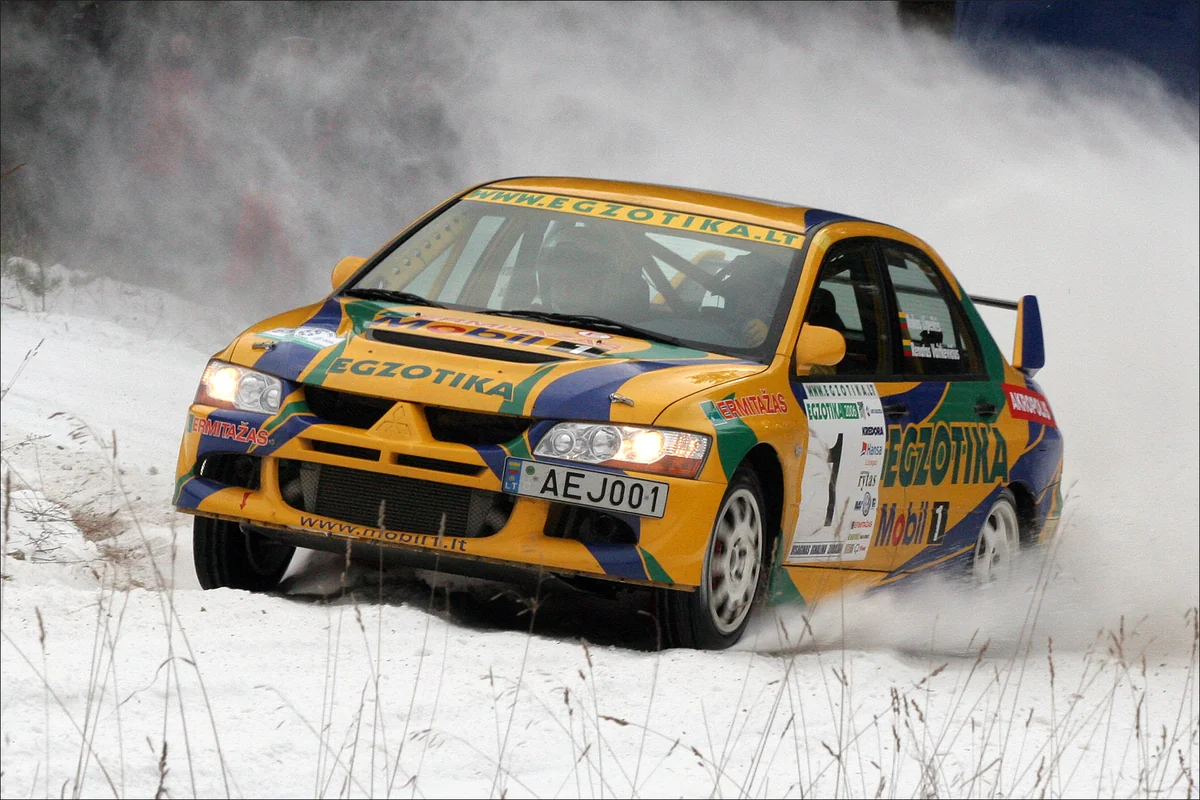
The fact that Rokas Lipeikis reigned over Lithuania's rally stages for 10 seasons says almost everything about his ability to control a car in the most demanding conditions. And yet, when the conversation turns to choosing tyres on the eve of winter, the retired racer admits to being a complete conservative: the best choice for our climate is studded tyres. Every other alternative, he says, is a greater or lesser compromise at the expense of road safety.
The rally master, famed for his exceptionally rational driving style and now head of the tyre retailer Egzotika, notes that although the last couple of winters have been relatively warm with little snow, it would be wrong to draw far-reaching conclusions about drivers' changing needs.
1. How should you choose winter tyres?
"Winter tyres must be chosen very responsibly, without taking the bait of all kinds of advertising — some of it shamelessly false. There are no tyres made specifically for our climate, and there is no in-between type or in-between compound, so the choice comes down to studded tyres, Nordic-type soft-compound tyres, and hard-compound tyres designed for Central Europe. Which of these to pick should be decided not by the 'good' letters on EU labels, which hint at braking distances in summer-like conditions, but by where and how you actually drive," explains Rokas Lipeikis.
2. Why studded tyres?
Lithuania is not northern Finland, but here too temperatures stay below zero for most of the winter, and the occasional thaws only complicate matters further, creating the most dangerous driving conditions of all: freezing rain and the especially treacherous black ice. In such conditions, quality studded tyres are the safest and most versatile choice — capable of saving more lives than seat belts.
3. Noise versus safety: how technology has moved on
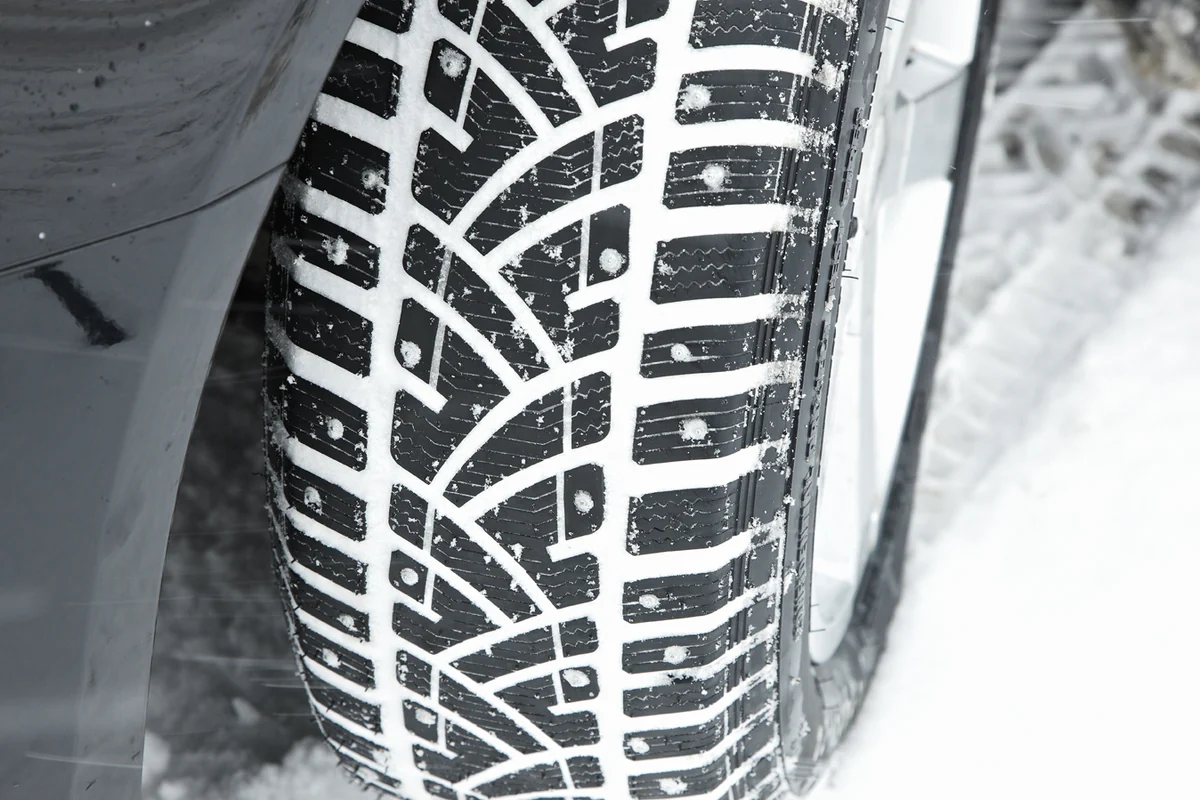
According to the experienced specialist, studded tyres have arguably just one drawback — they generate slightly more noise. But tyre manufacturers keep refining stud technology, and studded tyres are becoming ever quieter. Modern studded tyres carry twice as many studs as before, and the studs themselves are smaller and lighter, so the noise level has been reduced significantly while grip on icy surfaces has improved markedly. With today's noise-reduction technologies, the cabin noise of a studded tyre is only marginally higher than that of a non-studded one. And that is still a trifle compared with their working qualities — the ability to manoeuvre and avoid the worst outcomes in critical situations.
According to Lipeikis, the ability to keep the car under control matters even more than braking distance: the most painful consequences come not when you slide into the back of another car, but when a bend turns out to be too "sharp" and, control lost, the car drifts into the oncoming lane — or when you see a car hurtling straight at you and no longer have the chance to avoid a collision with a quick, decisive manoeuvre. "To sum up: on dry or wet roads you can drive safely on any winter tyres, but in the most extreme winter conditions studded tyres will be the safest. Drivers should decide for themselves what their bigger priority is; I am firmly convinced that safety on an icy road surface — something no winter has yet spared us — matters most," says Lipeikis.
4. Additional safety aspects
Experienced road-safety experts point out one more important detail: studded tyres roughen the surface of icy or hard-packed snowy roads, making subsequent driving considerably safer even for cars on ordinary winter tyres. Finally, when counting the cost of resurfacing stud-worn roads or repainting road markings, it is worth weighing the damage caused by accidents on slippery roads as well. Research by Scandinavian scientists shows that in genuinely wintry driving conditions studded tyres cut the likelihood of an accident by up to 40 per cent.
5. When studs are not an option — soft compound
Lipeikis recommends studded tyres for most drivers, with the exception of those who live in the biggest cities, mostly travel on very well-maintained motorways, or regularly drive to Western Europe or Poland, where studs are banned. If for reasons like these you have to compromise and give up studded tyres, the best choice is a soft-compound tyre.
"It is a perfectly good alternative for those who cannot use studded tyres. In difficult winter conditions such tyres yield to studded ones only on ice and on clean asphalt," advises the Egzotika strategist.
6. Myth vs. reality about soft compounds
Lipeikis also addresses some stereotypes about soft-compound tyres — that they supposedly "behave poorly on clean asphalt" or "wear out very quickly". That may have been true of soft-compound tyres designed 20 years ago, such as the Nokian Hakkapeliitta Q or the Dunlop Graspic DS3. Since then, however, manufacturers have developed and launched two or three new generations: the technology of today's modern soft-compound tyres is so refined that they are produced with T (up to 190 km/h) and H (up to 210 km/h) speed ratings, are designed for high-speed driving, and allow precise, effective manoeuvring both on clean asphalt and in the harshest winter conditions. The tyre-business professional notes that the braking distance of, say, a Bridgestone Blizzak VRX on clean asphalt is almost identical to that of the hard-compound Continental TS 830 — a car travelling at 100 km/h stops only a metre sooner on the latter. At lower speeds the difference would not be felt at all. The same goes for wear: if you do not drive on them in summer and avoid aggressive starts, hard braking and abrupt manoeuvres on asphalt, they will serve you for years.
7. Hard compound — not for our climate
"Hard-compound tyres are not bad in themselves, but they were created for Central European markets and are not suited to our climate: at low temperatures they harden considerably, grip suffers, and on ice they are completely unreliable. You meet icy roads even in the mildest winters — it takes just one slide into the oncoming lane in a bend for the consequences to be very painful," observes Lipeikis.
8. Are all-season tyres worth it?
The expert recommends resisting the temptation to drive on all-season tyres in winter. They are an option only if you are absolutely certain that the moments when you must rush somewhere urgently at any cost will never coincide with the very worst winter conditions — black ice, freezing rain, glazed frost and the like. All-season tyres are reasonably effective and safe on soft snow, but they stop "working" once the weather turns cold: on ice, such footwear is completely unsuitable for a car.
9. When to change tyres, and how deep should the tread be?
"Bear in mind that safe driving in winter conditions is only possible when the tread depth is at least 4 mm. Nor is it advisable to wait for the statutory tyre-change date — winter tyres outperform summer ones once the air temperature drops below 7 °C. On the other hand, fitting soft-compound tyres too early can have unwelcome consequences: tyres of this type are not designed for intensive use at higher temperatures, as they overheat quickly and make the car harder to control in critical situations. Some manufacturers advise against using soft tyres above 15 °C. If nature decides to play a joke and the weather suddenly warms up after the car has already been 'shod' for winter, it is wise to adopt a much gentler driving style and avoid long distances at high speed," stresses Lipeikis.
10. Tyre pressure — simple but critical
One more universal and very important thing is tyre pressure. Only by regularly checking that your tyres are inflated exactly as the technical recommendations specify will the car behave impeccably and your journeys stay as safe as possible. Both over-inflation and under-inflation can strongly affect how evenly tyres wear and how long they last.
Pressure should be checked and adjusted only when the tyres are cold — that is, when their temperature is close to the ambient temperature. A very common mistake is to stop at a filling station mid-journey and adjust the pressure of tyres that have already warmed up.
Safe travels to all drivers — Rokas Lipeikis, head of Egzotika!